
How Solar Farms Work
A clear, jargon-free explanation of how a solar farm generates electricity, connects to the grid, and earns income — from panels and inverters to the substation.
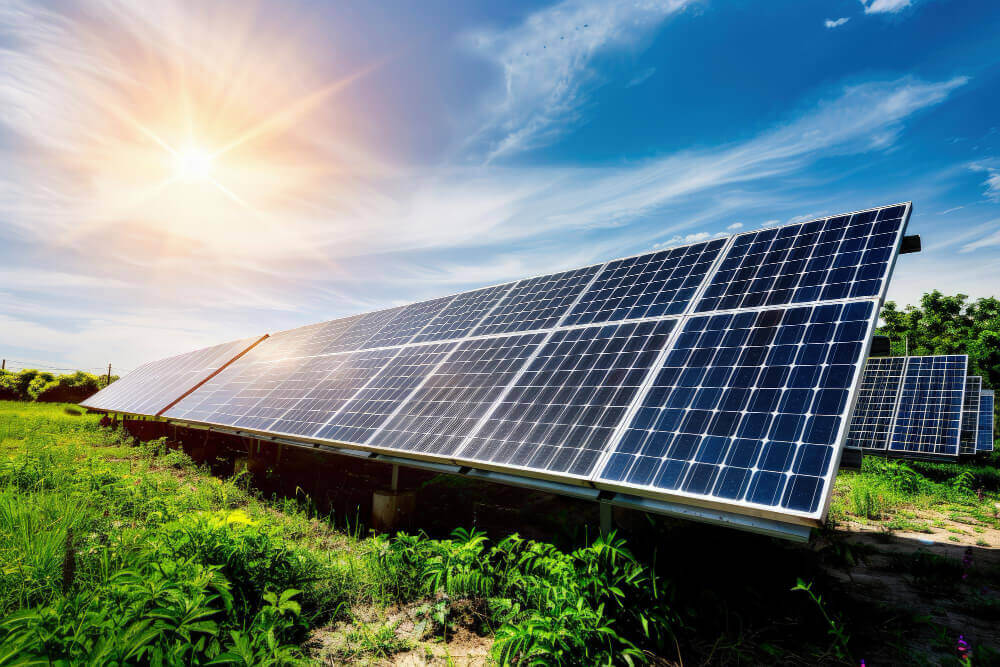
A solar farm is a ground-mounted array of solar panels that converts sunlight into electricity and exports it to the national grid. The principle is simple, but a working scheme brings together engineering, land and grid connection.
This guide walks through what actually happens on a solar farm, from the moment light hits a panel to the point the power reaches homes and businesses.
From sunlight to electricity
Solar photovoltaic (PV) panels are made of cells that release electrons when struck by daylight, producing direct current (DC) electricity. They generate whenever there is daylight — not only in direct summer sun — which is why solar works across the whole UK.
The DC electricity flows to inverters, which convert it into alternating current (AC) compatible with the grid. From there it passes through transformers and an on-site substation that steps the voltage up for export.
The main parts of a solar farm
A typical ground-mounted scheme is made up of a handful of components, most of them low-profile and quiet in operation.
- Panels & mounting frames — rows of panels fixed to steel frames driven into the ground, usually 2.5–3.5m at their highest point.
- Inverters & transformers — housed in compact cabins spread across the site.
- Substation — the connection point where power is exported to the grid.
- Cabling & security — mostly underground cabling, deer-style fencing and CCTV.
- Landscaping — hedgerows, wildflower margins and grassland between and beneath the rows.
Connecting to the grid
Every solar farm needs a grid connection — a point where the local network can accept its power. Securing a viable, affordable connection is one of the most important early steps, and grid capacity often determines whether a site works at all.
This is why an honest feasibility check matters before any commitment: a beautiful field with no nearby capacity may not be developable, while a more modest site close to a substation could be ideal.
How a solar farm earns money
Once operating, a solar farm sells the electricity it generates, typically through long-term power purchase agreements. For landowners, the income usually comes as a fixed, index-linked annual rent for leasing the land — independent of how much the sun shines or how energy markets move.
Frequently asked questions
Do solar farms work in the cloudy UK climate?
Yes. Panels generate from daylight, not just direct sun, and the UK has more than enough irradiance for solar farms to be productive and commercially viable across all four nations.
How long does a solar farm last?
Modern solar farms are designed to operate for around 40 years. At end of life the equipment is removed and the land is restored, usually secured by a decommissioning bond.
Are solar farms noisy?
They are very quiet. The only sound comes from inverters and transformers, which are low and barely audible at the site boundary.
How much land does a solar farm need?
Schemes vary widely, from a few acres to several hundred. As a rough guide, around 4–6 acres can support roughly 1 MW of capacity, depending on layout and technology.

Find out what your land could earn
Send us your location and acreage and we'll come back with an honest, no-obligation assessment of your site's solar potential — usually within two working days.
Request a Free Land Review